What the Global Wellness Economy Monitor 2026 Tells Those Who Design, Manage, and Equip a Spa
By Stefano Moretti, CEO of Aquaform.
Every year, with the release of the Global Wellness Institute Monitor, I look first and foremost for a clear indication: which choices guide spending when people decide to take care of themselves. The 2026 edition outlines a trajectory that, for those of us working in this field, is immediately recognizable: it leads toward water.
The Numbers, in Brief
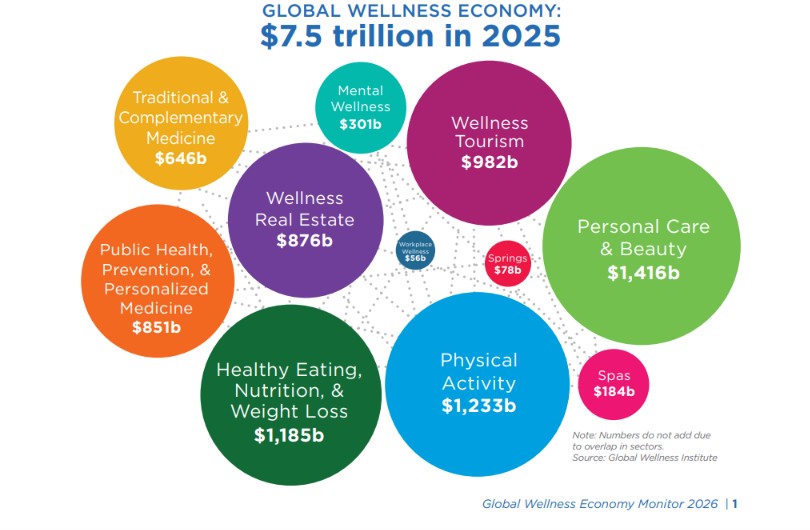
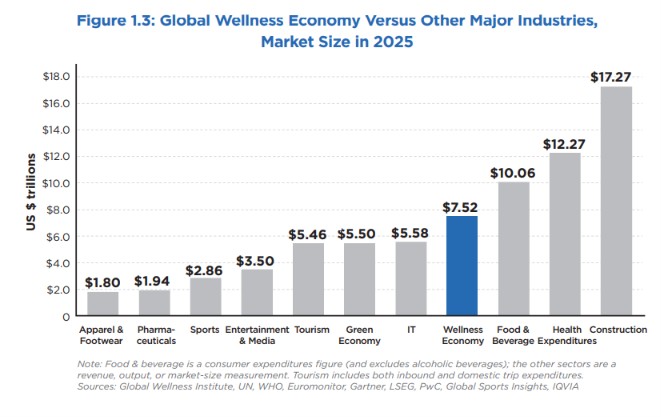
In 2025, the global wellness economy reached $7.5 trillion, up 8.9% from the previous year and representing 6.36% of world GDP. The GWI projects it to reach $10.9 trillion by 2030. Within this picture, the two sectors closest to our work are growing faster than average: spas surpassed $184 billion (+12.8% over 2024, or 153% of 2019 levels), and thermal/mineral springs reached $77.9 billion (+10.4%), with projected annual growth of 9.8% through 2030.
Europe is the world’s top spa market: $69 billion and more than 74,500 facilities. Italy ranks fifth globally for spa revenue ($5.84 billion, +13.5% in 2025), fifth for thermal springs ($2.11 billion), and seventh for wellness tourism ($24 billion, +12.7%).
The report candidly highlights a crucial point: part of the recorded growth stems from the fact that more and more hotels are listing themselves as spa properties on booking platforms, even when offering only minimal facilities. While this caveat is essential for reading the data accurately, the sector's overall upward trajectory remains unchanged.
The Figure That Interests Me Most
It is none of the above. It is an observation the GWI makes almost in passing: in Europe, spas are growing mainly because each visitor spends more, not because new facilities are opening. Between 2019 and 2025, 82 more were counted, rising from 6,487 to 6,569. And in Italy, wellness trips are still fewer than in 2019, while expenditure has surpassed pre-pandemic levels because each trip is worth more.
Fewer people, more value per person. For those managing a property, this means growth cannot be bought with square footage: it is earned by giving guests reasons to stay longer, return, and share their experience. For those equipping it, it means water can no longer be a mere amenity.
From Amenity to Ritual
The GWI describes with precision what is happening. Hydrotherapy circuits, hammams, ice baths, and a public "discovering" cold plunges and contrast baths even where there is no tradition of public bathing. Baths and saunas becoming social gathering spaces, priced less prohibitively than classic luxury and able to bring younger generations into the wellness world. Demand is increasingly oriented toward stress, sleep, and mental balance: guided rituals, breathwork, and deep listening.
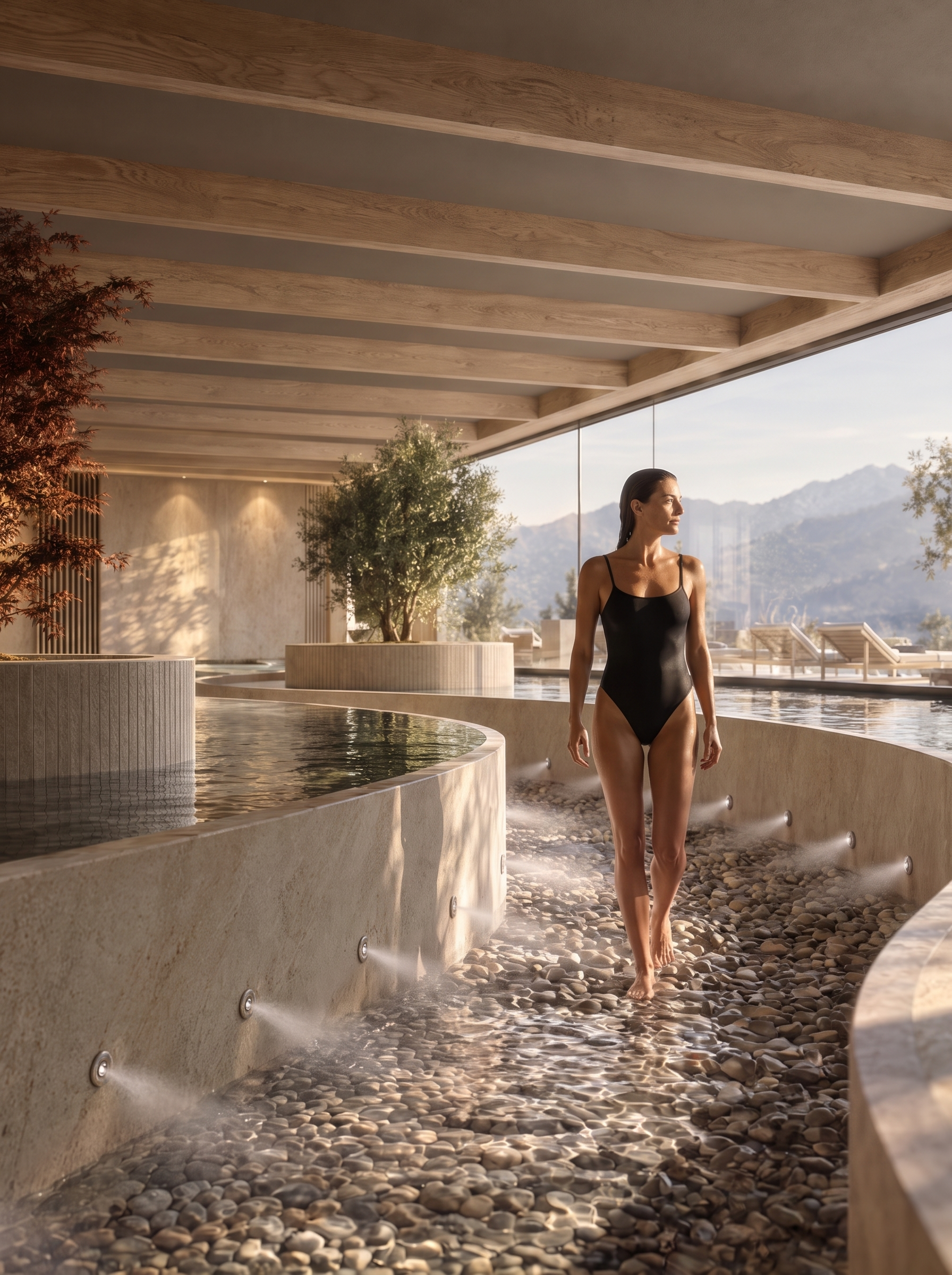
These are three trends with the same denominator: water is the most natural medium for building a sequence. Hot, cold, jet, pause. A Kneipp circuit has an order, a rhythm, a before and an after. A contrast shower has an intensity chosen by the guest. An experience shower puts light, scent, temperature, and pressure at the service of an atmosphere. These tools originated in different eras and for different purposes, yet today they work for the same reason: they make something happen over time, and people remember it.
My conviction, as a manufacturer, is that in this landscape the spa that will grow is the one that designs the journey before choosing the equipmnet. Not "where do I put the shower," but "what should the guest feel when stepping out of the sauna, and what happens in the minutes that follow."
Water Is Also a Cost
The report devotes space to a less glamorous issue: rising energy and water costs, regulations on water use and treatment, the need for recovery and recycling, and infrastructure in need of modernization. In Europe, staff shortages also weigh heavily. These are two reasons why I believe a well-conceived water journey is not only an experience, but a management choice: an experience a guest can enjoy independently requires less supervision, and a system that balances output with consumption pays for itself on the utility bill every month. Designing the effect and designing the consumption, for us, are the same operation.
What I Take Away
The Global Wellness Economy Monitor measures wellness in dollars. To me, it also seems to say something else: people are willing to pay for time that changes them, and water is the oldest, simplest, and still most effective way we know to give it to them. Our job is to make it designable.
DISCOVER ALSO